
We examined transactions that minFraud clients reported back to us as chargebacks, and analyzed what share of the fraud-coded ones showed signs of anonymization, and which kinds. Close to half of chargebacks in our analysis were associated with some form of anonymizer, versus roughly a fifth of ordinary transactions. The breakdown below tells you which anonymization methods dominate confirmed card fraud, by how wide a margin, and why the largest category is also the hardest to detect reliably.
Residential proxies dominate the anonymized slice
Of the chargeback-reported transactions that were anonymized, at least 70% traced to residential proxies. Put on the scale of all chargeback-reported transactions, roughly one in three came from a residential proxy detected by active probing versus roughly one in six ordinary transactions.
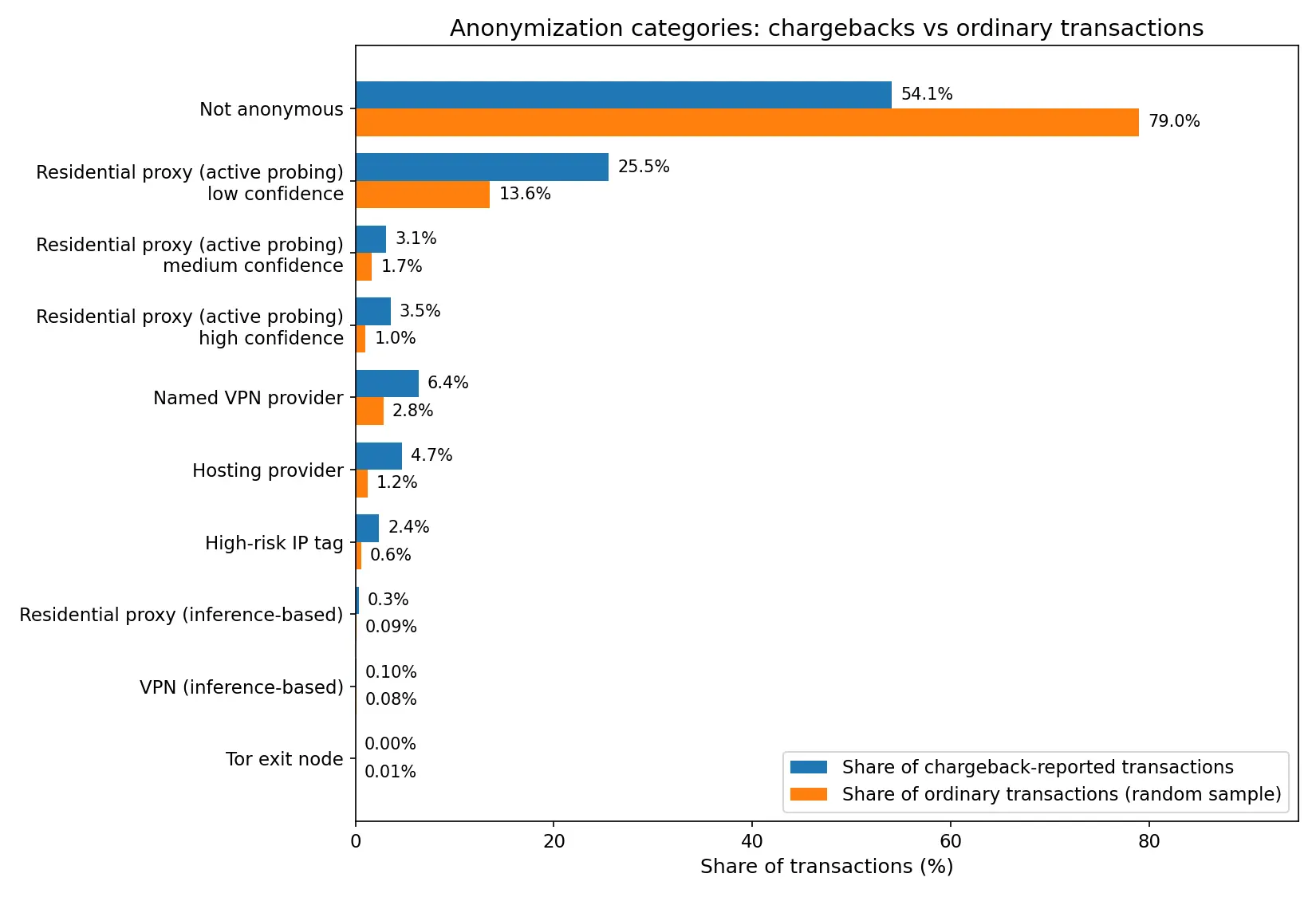
Each transaction is counted once, in its most specific matching category. The upper bar in each pair is the share of fraud-coded chargeback-reported transactions, the lower is the share of a random sample of ordinary transactions.
What this means is that the method that looks most like legitimate traffic, and also defeats geographic checks and static IP lists at the same time, accounts for most of the anonymized fraud we see.
What one in six ordinary transactions really means
A residential proxy showing up in one of every six ordinary transactions should give you pause, and it’s worth thinking about why that number is as high as it is. Residential proxy detection doesn’t only identify ‘rented’ living rooms. It also picks up on shared infrastructure like carrier-grade NAT, where many unrelated people sit behind one address. Shared infrastructure can look like proxy infrastructure from the outside, because in both cases traffic from many different people originates from a single IP.
That distinction is what the confidence bands in Chart 1 separate. Most residential proxy detections fall into the low-confidence band, which is where we tag/identify shared infrastructure. A low-confidence detection is better read as “many people use this address, and some of that traffic may be proxy traffic” than as “this address is a proxy.”
Those detections still carry risk, though. If they were mostly errors, they would appear in chargebacks at roughly the same rate they appear in ordinary transactions. Instead they appear about twice as often, and high-confidence detections appear about three and a half times as often. Confidence therefore tells you two things: how likely it is that a network is a proxy, and how much fraud to expect from it. That is why these detections are more useful as weighted inputs than as a single yes or no.
Why simple, static IP lists are ineffective
Static IP lists work well against datacenter proxies, which sit at stable addresses in known ranges. Residential proxies are a harder problem, because the addresses they use are ordinary home connections that serve real customers both before and after the proxy traffic passes through. Proxy networks also rotate through millions of addresses, so an address rarely stays associated with abuse long enough for a list to be useful. By the time a list reaches you, a good portion of it is stale.
That leaves direct observation as the practical option: probing address space to confirm that a proxy is actually running, and tracking how recently we saw it operating.
There are two ways an IP picks up a residential proxy label in our data. Active probing identifies individual residential IPs operating as proxies right now or at some point in the recent past. The inference-based signal identifies something different: IP ranges that major ISPs route as residential through Bring Your Own IP programs, where traffic across the range looks like high-risk infrastructure rather than household use. Because those changes happen at the ASN level, the label describes a network rather than a single address.
Active probing accounts for far more of what you’ll see in practice, covering about a third of all chargeback-reported transactions against a fraction of a percent for the inference-based signal. That makes it the one to build on first, though the inference-based signal is still worth acting on as the transactions it flags are about three and a half times more likely to be charged back than average.
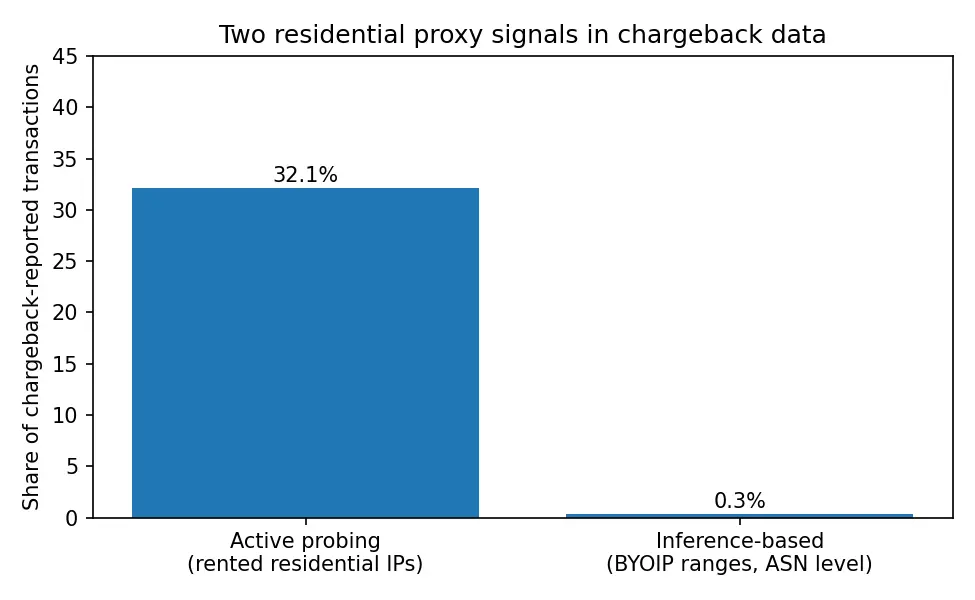
Share of chargeback-reported transactions carrying each of our two residential proxy signals. Active probing identifies individual residential IPs operating as proxies. The inference-based signal identifies residential ranges routed through Bring Your Own IP programs, applied at the ASN level.
What we did about it
We’ve incorporated probe-based residential proxy risk directly into minFraud’s real-time IP risk scoring, so this signal now affects the risk score on transactions you send us—without any integration change on your side. In our model evaluations, probe-based residential proxy data improved precision-recall performance (PR-AUC) by an estimated 1 to 2%, which in practice means catching more fraud at the same false positive cost.
For clients who want the detections themselves, they’re exposed in a new residential sub-object under the anonymizer object in GeoIP Insights and minFraud Insights and Factors: a 1-to-99 confidence score, the date the network was last seen operating as a proxy, and the proxy provider’s name. The residential object can be present even when no other anonymizer field is populated.
Residential proxy detection is probabilistic, so we publish a confidence score rather than a flag. Detections range from proxies we’ve confirmed are currently active down to addresses where the evidence is older or the infrastructure is shared. The gap between those cases is wide enough to act on, since high-confidence detections are close to twice as concentrated in chargebacks as low-confidence ones. A high-confidence detection on a high-exposure transaction is worth acting on directly. A low-confidence detection is better used as a few points of added risk, or in a rule that only fires when something else corroborates it.
A note on method
Transactions were assigned to a single anonymization category each, in a fixed order from most to least specific signal, so no transaction is counted twice and subset signals (a named VPN provider, for instance) win over broader ones (hosting). Residential proxy categories sat near the end of that order, which is why we describe their share as a floor. Confidence bands follow our published anonymizer confidence score: low is the band where networks are most likely to be shared infrastructure and carries the greatest false positive risk, and high is where networks are most likely to be actively operating proxies. The “high-risk IP tag” covers IPs tagged as proxies in minFraud through inference from risky activity observed across our network. The dataset covers chargeback-reported transactions from minFraud clients from April to mid-August 2026.